






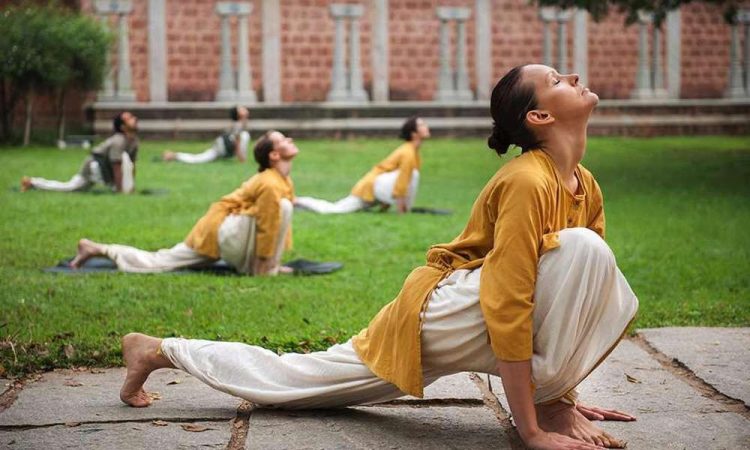
Why does self-discovery start?
Self-discovery begins during yoga teacher training because the daily routine takes away the usual ways of stepping aside from oneself. Mornings open before dawn. Meals are taken without speech. Practice runs through most of the waking hours. You can’t reach for the phone, no task has your attention, no old social role is waiting. One week after arriving with years of habits, trainees discover they have nothing to fall back on. Most who choose Yoga Teacher Training in Thailand describe this stretch as the hardest part of the course, not for the body, but for the way silence brings forward what daily life had quietly buried.
The mat serves as the first mirror. Holdings that were once invisible start showing during practice. A locked jaw in forward folds. A held breath during balances. Shoulders pulled high in seated meditation. None were chosen on purpose, yet each took hold at some point and stayed. Training brings them forward at their own pace, without force. The group becomes the second mirror. By the second week, polite introductions fall away, and plainer speech takes their place. Students share what they came to set down, what they avoided, and what no one heard at home. No one rushes to break the silence in the evenings. There is a quiet trust that carries its own weight, and the inner work begins.
How does discovery deepen?
Discovery deepens because repetition shows what variety hides. The same sun salutation done each morning for thirty days teaches more than any new sequence ever could. A trainee stops reaching for harder shapes and listens to familiar ones. A standing forward bend on day twenty carries the same weight as the fold never held on day three. Small changes appear during the middle weeks:
- Breath grows longer on its own, and the gap between inhale and exhale stretches.
- Sleep settles into a heavier rest, and old dreams return after years away.
- Mental noise softens, especially in the hours just after morning practice.
- Meals slow down, and tastes register more fully than they used to.
- Small frustrations pass through without taking hold the way they once did.
None of these arrives on demand. They show up on their own clock, often spotted only in hindsight. A trainee might sit on a quiet afternoon and notice that something heavy has been gone for days, though the moment of its leaving cannot be named.
Meeting the self
Philosophy sessions land with a weight most trainees never saw coming. The texts are old, the questions older still, yet they press against present concerns with uncomfortable accuracy. Teachers resist neat answers. They leave space for whatever rises, even confusion or quiet resistance. Discussion in these classes moves slowly. A question gets asked. Stillness follows. Someone speaks, then more stillness. That rhythm teaches what words alone cannot. Trainees begin to see how often they had been replying before truly listening, choosing before genuinely weighing. The slower pace of the classroom seeps into how they think outside it.
By the end of the day, voices had changed. Cues are spoken with more space between them. Instructions sound drawn from lived experience rather than borrowed lines. Someone familiar to them has been replaced weeks earlier, not by a new trainee, but by someone more familiar. It turned out to be preparation for something bigger than teaching.

5 Reasons Why Havening is the New “Secret Weapon” for Peak Performance

In the high-stakes worlds of professional sports, executive leadership, and the performing arts, the difference between a gold medal and...
The Science and Subtle Art of Gua Sha Massage in Singapore You Need To Know

Key TakeawaysGua sha massage treatments in Singapore are rooted in traditional East Asian medicine and supported by modern-day research on...

Back Massager in Singapore: Top Features to Consider Before Buying
With long working hours and extended screen time, back tension has become a common concern for many office workers and...

What Are the Different Oils Used for Ayurvedic Massage?


Oil is the most important component of any Ayurvedic massage. If you book a massage at a reputable Ayurvedic clinic...